Levine Concert Appearance Cancelled; President Polisi and Dean Guzelimian Issue Statement

The School responds to the recent news regarding James Levine

To the Members of the Juilliard Community,

The Juilliard Orchestra has a scheduled collaborative concert with the Metropolitan Opera’s Lindemann Young Artist Development Program on February 23, 2018, which was to be conducted by James Levine. In light of recent reports, Mr. Levine will no longer be conducting the concert. We are now actively searching for a conductor to take over the concert.

The Juilliard School is committed to providing a safe and supportive environment for all members of the community. Sexual misconduct is a violation of trust that can never be tolerated. Our hearts go out to the individuals who have physically and psychologically suffered from acts of sexual misconduct.

Joseph W. Polisi, President

Ara Guzelimian, Provost and Dean

An Education in Representation

In the Juilliard feature for the Wall Street Journal’s lifestyle magazine, many of the featured students are non-white. Each division is represented. The group seems diverse. Except, that is, for one glaring omission: none of them identify as Asian or Asian American.

It is possible to sit in Juilliard’s Student Multipurpose Room and not see any students. To the southwest, a wall of glass looks out onto the Illumination Lawn, the Pool through the windows of Lincoln Ristorante, and the tops of the trees in the Grove. To the northwest, windows overlook a rarely used walkway and the wide chasm between the SMR and the Student Lounge. Far from the barefoot dancers, rowdy opera singers and discordant practice rooms, this room is where ‘contained’ events at Juilliard take place; opening night receptions, closed faculty meetings, Juilliard ‘Spotlight’ video shoots, and visiting therapy dogs all find safe haven here.

One Monday in December, the day after the first snow flurries of the season, The Wall Street Journal set up shop in the SMR. Two representatives from WSJ. Magazine (tagline: “The Luxury of Choice”), accompanied by an assistant from the Juilliard Development & Public Affairs office, individually met with students during an “open call” for a forthcoming feature on “the people at Juilliard who make it what it is.”

Some students and observers have cried foul on just that: who makes Juilliard what it is, and who decides?

The piece, titled “An Education,” which ran online April 3 (behind a paywall) and in the April issue of the print edition, featured 11 students from across the three divisions. Photographed in various locations around Juilliard, the actors, dancers and musicians are dressed in mostly borrowed clothes, identified by brand in the captions. An Alexander McQueen sweater. A Burberry belt. Prada pants. An Alexander Wang long-sleeve bodysuit. A Gucci vest. In the online version, prices accompany the captions. $3,565. $285. $550. $160. $2,300. “I definitely wasn’t expecting to walk into a room with all this wardrobe. There was so much—clothes, shoes, jewelry,” said Katherine Turner (Drama ’20).

The students look as serious and self-possessed as any model might. “It was so professional,” said Jeffery Miller (Jazz ’18). In the print edition, an introductory paragraph tells of the school’s history, its current leadership transition, and its prestige. The photographs are accompanied by quotes from the students about their hopes, gratitude, passions and crafts. “I thought it was cool that it was more than just pictures,” said Turner. “They get to have a little snippet of who I am as an artist.”

“Wait. Wait, where are the Asians?” —Mosa Tsay (Music ’18)

Many of the featured students are non-white. Each division is represented. The group seems diverse.

Except, that is, for one glaring omission: none of them identify as Asian or Asian American. This school year at Juilliard, one out of every three college students identifies as being primarily of Asian ethnicity. In undergraduate music, ethnically Asian students are the majority. According to the Admissions office, of the 5,500 applicants for next year’s graduate and undergraduate classes who chose to respond, “nearly 20% identified as Asian or Asian/Pacific Islander.”

Given that large population, Fala Chen (Drama ’18) was “expecting to see some Asian faces.” Connor Kim (Music ’18), a first-generation Korean American, called the piece a “blatant misrepresentation,” adding that it “just provides an excuse to dampen our existence.” When Mosa Tsay (Music ’18) scrolled to the end of the article, she thought, “Wait. Wait, where are the Asians?” Tsay said Asian success at Juilliard “is a source of pride,” noting how in Taiwan, she often encounters people who respect Juilliard and are familiar with Taiwanese alumni like the renowned violinist Cho-Liang Lin. The oversight bothered and puzzled her and many students of Asian descent. “Is it because they’ve never set foot in Juilliard?” she wondered of the editors. It’s possible that those who made the final selection hadn’t.

Tsay was taken aback by her own reaction. “I felt sick to my stomach, confused, and as though someone had ignored me,” she wrote. Tsay, who is of Taiwanese descent, took Asian American courses during undergrad at UC Berkeley, where ongoing conversations introduced her to ideas of ‘Otherness’ and ‘Forever Foreigners.’ It’s not a conversation that she hears happening at Juilliard, she said.

Outrage and baffled curiosity didn’t come only from the students of Asian descent. “It saddened me greatly to see the lack of Asian and Asian-American representation,” wrote one Caucasian student who participated in the shoot. The student didn’t know who would be in the final roster of featured students. “I am still very grateful for being a part of the WSJ article,” posted Taylor Massa (Dance ’20), one of the featured students, “however I am disappointed with the total exclusion of any Asian students.”

Many saw “An Education” as a positive representation of African American students at Juilliard; almost half of the featured students were African American. While some African American students saw it as positive representation, they, too, wondered where the Asian representation was. “It was great to see us represented in such a dope way,” said Miller; but when it came to the Magazine’s choice not to include students of Asian descent, he asked, “How do you miss that?” Turner also appreciated the representation of African American students like herself. She and her family thought it was “super-cool,” but, she added, “it would have also been cool to see people of Asian descent.”

Some students dealt with their frustration by contacting those responsible for the piece. Carlos Avila (BM ’08, MM ’10), a Filipino American alum, sent a letter to the editorial section of The Wall Street Journal, and said that “leaving us out completely in a piece designed to represent the school” was irresponsible.

Tsay tweeted to @WSJMag on April 9, asking, “Was this intentional, to not photograph any Asian students?” Following the advice of one of her professors, she had written an email to Thomas Gebremedhin, the writer of the article, on April 3. She told Gebremedhin that the lack of Asian representation “struck me surprisingly hard in the gut.” She sent a follow-up on April 10. Later, Tsay said she had felt “stuck in this kind of gray area of wanting to do something but not wanting to be perceived to be angry or irrational or emotional.”

Neither Tsay nor Avila have received responses from The Wall Street Journal, WSJ. Magazine or anyone involved outside Juilliard. “Maybe I wasn’t angry enough,” said Tsay.

closed call

33 students in total attended the ‘open call’ in December. “It was a very quick process to just take your picture and write down your major and go and see if you’re asked to come for the shoot,” said Turner.

Many music students were unaware of the opportunity because they hadn’t been informed about it. Tsay, too, hadn’t received an email about it. “It wasn’t really an ‘open call,’ in that respect,” she said.

The PR request from WSJ. Magazine had been forwarded to department heads, so relaying the invitation to students was up to their discretion. Dance, Drama, Historical Performance, Jazz, and Vocal Arts students received the information, but the Music Division as a whole did not. “We get dozens of PR requests every year, and quite honestly this one slipped by me,” wrote Dean Adam Meyer, Director of the Music Division.

Alexandra Day, Associate Vice President for Marketing and Communications, oversaw the communication between WSJ. Magazine and the students. “We don’t email the student body directly with PR requests, which I have to agree with, even, as a PR person. Because otherwise, you would hear from me probably every 10 days while you’re trying to study, right? So I think that’s an appropriate workflow.” She added that she respects an individual department head’s “prerogative to not bother their students with something like that.”

It might be easy, then, to blame the school for not reaching out to departments where there are more Asian students. However, four students of Asian descent attended the initial meeting, and noting the lack of representation, Day’s office submitted photos of eight additional students, four of whom were of Asian descent. So, in the end, the portfolio of possible students had an Asian percentage close to the school’s applicant pool: nearly 20%. “I can really say, with confidence and pride, we presented a nice section of the student body,” said Day. “In my experience, it really varies by outlet how much you can control or not. We didn’t have say in that in this piece.”

So then, how did it happen that WSJ. Magazine neglected to select any student who identifies as Asian or Asian American?

Many assume the Asian students weren’t selected because of conscious or unconscious bias. One student wrote, “I’m a whitewash Asian so they probably would have picked me for their Asian demographic.” (‘Whitewashed,’ when referring to people, can be a perjorative term for non-white people who ‘act’ or ‘look’ white.)

Availability may have played a part in the decision, since editors were given access to the students’ schedules. As a policy, students aren’t pulled from class for PR opportunities. Indeed, one Asian student who attended the initial meeting had very few breaks during the day. However, one student of Chinese descent whose photo was considered had nothing official scheduled on the day of the shoot.

“I hesitate to assign motive in this instance, or subconscious neglect, because of how complicated it was for them logistically. I don’t want to make excuses for them, either,” said Day.

“…the black-white binary continues to be the dominant frame by which Americans see race relations in this country. In that kind of frame, Asians are expendable, or they get used as the butt of an easy joke.” —Ian Shin

Turner argued that every choice makes a statement. “So, I’m curious as to what kind of statement they were trying to make in who they chose.” The incident made many people interviewed for this article consider what diversity means inside and outside Juilliard. Sometimes, the “gatekeepers to mainstream visibility…think diversity is just black and white,” said Turner. However, she said, ethnic and racial “diversity is black, white, Asian, Latino, Native American. The list goes on.”

Ian Shin, a postdoctoral fellow and lecturer who teaches Asian American history at Bates College, wrote that “the black-white binary continues to be the dominant frame by which Americans see race relations in this country. In that kind of frame, Asians are expendable, or they get used as the butt of an easy joke.” He said it was up to Juilliard students to decide whether the piece was offensive or not. “But I do think it was intellectually lazy,” he said.

Whatever it was, the selection process remains unclear. It’s possible those who chose the featured students “never set foot in Juilliard.” The Citizen-Penguin has made multiple requests for comment, and none have been granted. Calls were made, emails were sent, LinkedIn connections were requested and tweets were tweeted to those involved outside Juilliard, including the publisher’s office of WSJ. Magazine, Sarah Schmidt (a managing editor at The Wall Street Journal), Thomas Gebremedhin (the writer of “An Education” and an associate editor at WSJ. Magazine) and even representatives of Zoë Gunter, the photographer. Each request received no response or was delegated elsewhere. Even one Juilliard administrator has received no response to their own follow-up attempt.

human-interest Burberry ad

Though some of the featured students were aware that it would be a fashion-heavy piece, some were surprised. Avery Amereau (Artist Diploma in Opera Studies ’17), who was “humbled” to be included, also wished for a more in-depth piece. “I had the impression it would be like an arts/human-interest piece,” she wrote. “It was more of a fashion advertisement with catch phrases. I say that with complete respect; my opinion is that it could have been a lot deeper.” Chen also hoped for a deeper view into life at Juilliard. “You hear, ‘Oh, you’re a Juilliard student.’ There’s a certain mystique that comes with that name.”

Day often encounters the question of control in the “earned media” space while advising students and alumni on matters of press. (Earned media could be a feature, interview, or review—any press granted by an outside publication or media outlet where Juilliard doesn’t have final say in how the piece appears.) “Would I have rather had thoughtful pieces that were not about fashion? Personally, yes,” said Day. “We wouldn’t have had coverage in The Wall Street Journal in that case. That’s a choice. And I think that’ll be a choice for our artists as they are approached by various outlets that say, ‘We’d like to feature you in these ways.’”

Earned media doesn’t always go well. Day once worked for an opera star, and remembered a feature that turned out to be more fashion-focused than the star expected. “And she kind of sighed and said, ‘You know, would I have wanted them to focus on the price of my Burberry jacket? No. Am I happy that someone who now sees my name and thinks they might buy a ticket and go to their first ever opera as a result?’ That was enough for her. It wouldn’t be for everyone, I guess.”

“For as long as I’m here, I don’t think I’ll ever really shy away unless I consider it a high risk.” —Alexandra Day

Misses notwithstanding, Day still believes in the power of earned media. “For as long as I’m here, I don’t think I’ll ever really shy away unless I consider it a high risk,” she said. She thinks coverage is particularly important in the current political climate, where arts funding is constantly being threatened and coverage of the arts is dwindling. “It’s not only overall representation, as in, ‘Is this accurate? Is this who we are?’ But also, ‘Are you paying attention to us at all?’” She sees Juilliard President Joseph Polisi as an example of someone who uses press opportunities for Juilliard as an opportunity to serve as an ambassador for the arts in general. She said, “I want people to be thinking about the value of the arts, as cheesy as that sounds.”

Still, wrote Day, earned media can be “a lot trickier, since we can’t control how the press represents Juilliard (or any institution).” When it comes to things Juilliard can control, though, she wrote, “We strive to celebrate the entire Juilliard community in all that we do.”

Asian representation in the media

Beyond just representing Juilliard’s diversity, the feature’s lack of Asian representation indicated what some see as a problem in the media at large. One Chinese student was disappointed in the choice to include no students of Asian descent because news outlets like The Wall Street Journal purport to reflect our society’s values. “It’s not the right thing to do,” she said. “A mainstream media leader such as The Wall Street Journal should have thought about it more.” Day said artists and institutions are still dependent upon those media leaders. “The world still relies on the platinum-tier outlets, like the Times or the Journal to create that buzz or awareness,” she said.

Many note the absence of Asian faces in much of American Fashion. “Why are Asians or Asian Americans largely invisible in the world of fashion?” wondered Tsay. “That’s really at the heart of it for me.”

Mandy Dyonne Lieveld, a coach for runway models who led a workshop at Juilliard last year, wrote that “in print you see more and more Asian models,” citing Armani’s recent ads as an example. The runway is improving, too, said Lieveld. A trend towards what are considered “unique and different looks” has opened doors for diversity. Economics have helped, too; Victoria’s Secret runway shows had no Asian models in 2009, but one year after opening shop in China in 2015, their runway shows had four Asian models, Lieveld notes.

“I mean, it’s simply about time that we have more Asian faces across all media, be it in print, on screen or on stage.” —Fala Chen (Drama ’18)

But, said Lieveld, in terms of a perfect “reflection of society…we’re still not there yet.”

Chen sees hope ahead for Asian representation in the media. “The growing spending-powers in Asian markets, the Chinese market especially, makes it inevitable that Asian faces will be in higher demand.… I mean, it’s simply about time that we have more Asian faces across all media, be it in print, on screen or on stage.” Shin, too, sees increased awareness and hope in the media in the form of an increasing amount of “some really smart portrayals that play with and challenge stereotypes about Asians and Asian Americans.”

an emerging conversation

“An Education” made students wonder about ways in which minorities interact inside and outside Juilliard. In the outside world, the dominant group in many societies often holds onto power by pitting subdominant groups against each other. A recent New York Magazine op-ed by Andrew Sullivan wondered why African Americans couldn’t assimilate into American society as well as Asian Americans could, despite the fact that both had suffered hardships; the piece accepts the idea of the ‘Model Minority‘ as a premise. Kat Chow of Code Switch at NPR wrote in response to the op-ed that “at the root of Sullivan’s pernicious argument is the idea that black failure and Asian success cannot be explained by inequities and racism, and that they are one and the same; this allows a segment of white America to avoid any responsibility for addressing racism or the damage it continues to inflict.” She calls the ‘Model Minority’ myth a “classic and tenacious conservative strategy.”

“Slowly, I see individuals, whether it be digitally or in person…trying to knock down those walls…We have to all be vying for each other.” —Katherine Turner (Drama ’20)

Turner has observed walls between Asian and African American communities outside Juilliard, but notes a shift. “Slowly, I see individuals, whether it be digitally or in person…trying to knock down those walls…We have to all be vying for each other.” To fully knock down those walls, Turner points to a need for deeper change than simply filling quotas. “I want to go to the root of the issue and start to show these communities—Black, Latino, Asian, whatever it might be—that you’re not limited, you know? Or, you’re not excluded from this. If this is something you’re interested in, you can pursue it, train in it, and continue on in your life in it.”

Inside Juilliard, Turner doesn’t see those walls, but notes that there could be more encounters between communities.

Tsay remembers one quiet evening at Juilliard when “everyone was either practicing or at home.” She was sitting by the windows on the fifth floor, overlooking Broadway, with her headphones in. After a while, two African American students sat next to her and started catching up. Their conversation caught her ear when they started talking about microaggressions: insensitive things being said in the classroom, repeatedly not getting called on even though their hands were raised, and not being able to express themselves fully in a group setting. Tsay thought, “‘Wow. This stuff is really happening.’” She didn’t want to admit she had been eavesdropping, but she had wanted to say, “‘I hear you, and I’m so sorry that this is happening.’” She added that those conversations are happening around campus, but they tend to stay between members of the same groups.

Tsay said she often catches herself worried that starting conversations around race might make people uncomfortable. “I think it’s okay. I think they understand, too.” Shin credits these conversations as the source of a recent increase in awareness around Asian representation. “It’s happened because Asian Americans like Constance Wu, along with their allies, have spoken up and demanded fairer treatment,” said Shin. “In that vein, I think it’s great that Juilliard students are raising these issues and challenging a situation that they see as unfair.”

The more Tsay has tried to “figure out” race, or what it means to be Asian American, the more she feels like she’s “looking into this black hole…being drawn into something [she doesn’t] understand.” But that’s not stopping her.

“It’s all very nuanced, and I think it’s just healthy to keep asking questions,” said Tsay. “And that’s what I’m going to keep doing, until someone answers them.”

Snow Day 2—Resurgence

All classes, performances and rehearsals are cancelled and administrative offices closed. Check this space for updates.

Welcome back. Did you get some sun over spring break? Good. Here’s a blizzard.

And our second snow day.

All classes, rehearsals and performances are cancelled and administrative offices are closed today, Tuesday, March 14.

Today’s recitals to be rescheduled:
Hayaka Komatsu, Viola
4 p.m., Paul Recital Hall

Yu Gong, Violin
6 p.m., Paul Recital Hall

Jeremiah Blacklow, Violin and Sung-Moon Park, Cello
6 p.m., Morse Recital Hall

Yuchong Wu, Piano
8 p.m., Paul Recital Hall

Juilliard at the Oscars

“There’s one place where all the people with the greatest potential are gathered—one place—and that’s the graveyard,” Oscar-winner Viola Davis said.

Viola Davis, Group 22, won best supporting actress for her performance in Fences, and host Jimmy Kimmell (rightly) quipped that she deserved an Emmy for her acceptance speech. “There’s one place where all the people with the greatest potential are gathered—one place—and that’s the graveyard,” Davis said. Listen to her speech below.

Davis’s acceptance speech also included a shoutout to Fences castmate Stephen McKinley Henderson, member of Group 1 and a master class instructor.

Another nominee was pre-college alum Nicholas Britell, for his work on the score of Moonlight.

Another winner, Tarell Alvin McCraney (best picture winner Moonlight’s adapted screenplay writer), was once rejected by Juilliard.

Drama Division Director Search Nears End

After months of deliberations and interviews, the search for a new Director of the Drama Division has entered its final phase. Jim Houghton’s legacy has had a profound effect on the goals of the committee, helping them to establish a mold for the ideal new Director. Dean Guzelimian, students, and alumni shared their thoughts on the future of the Drama Division.

After months of deliberations and interviews, the search for a new Director of the Drama Division has entered its final phase. Jim Houghton’s legacy has had a profound effect on the goals of the committee, helping them to establish a mold for the ideal new Director. Dean Guzelimian, students, and alumni shared their thoughts on the future of the Drama Division.

Since the job was posted on the Juilliard website on September 20, 2016, the committee has been working tirelessly to whittle down the list. The initial pool consisted of those who applied to the job posting and individuals who were contacted and asked to apply, as a recommendation from faculty, staff, theater professionals, students, and alumni.

“Some of those contacted expressed interest but could not pursue the position because of professional commitments, personal and family reasons, etc.” Dean Guzelimian wrote in an email to the Drama Division earlier this month. “But many of those contacted did indeed express their desire to enter into the conversation and submitted applications.”

For the first round, the committee interviewed, via video conferencing or in person, a “manageable number” of candidates; the semi-final round involved in-person interviews in New York. Once the committee finishes with deliberations, they will invite back one to three candidates for the final round: a series of structured meetings with “faculty, staff, and representative groups of current students, as well as alumni, trustees, and other Juilliard staff members,” according to Dean Guzelimian’s email.

“It’s like callback weekend,” said Dean Guzelimian in a recent interview. “It’s for both parties to determine if this is the right fit. It’s for the candidate to say, ‘Ah, I can see this.’ And for us to say ‘Yep, that’s a fit.’”

As this is an internal appointment at Juilliard, President Polisi has been managing the process. Members of the board of trustees will weigh in at the final round; given their focus on more macro-level decisions, they will remain relatively uninvolved until that point.

Jim Houghton’s huge impact on the trajectory of the Drama Division has played an essential role in deliberations.

“Jim is such an inspiring model that everybody came in with a fairly clear view of what we want the next person to be,” said Dean Guzelimian. “I see us now evolving from what Jim has built rather than going back.”

“I think it’s an opportunity to make a strong statement.”

That evolution includes a continued commitment to diversity, new works, increased scholarships for Drama students, and renovations to the existing spaces.

“It is our wish that the new Artistic Director of the Drama Division be an educator, an active and practicing member of the theater community, with a profound dedication to the growth and development of the young actor and playwright, and a deep commitment to broadening the diversity of voices in theater and to nurturing the citizen-artist,” Dean Guzelimian wrote.

Guzelimian expanded on this description, saying that the committee was in search of someone “who understands that this is first and foremost an educational experience but it’s an educational experience constantly with a foot in the professional world.” He said the Director should also be comfortable in speaking to donors and potential funders about giving to the Drama Division, be dedicated to the playwriting program, and have demonstrated skills in fostering community.

Drama students and alumni weighed in on the search, with a particular interest in forward-thinking and culturally conscious leaders.

“Somebody who is aware of how things are changing in art,” said Brittany Bradford (Group 47), “and is trying to be on the front edge of that instead of trying to stick to some traditional mode of teaching.”

A commitment to diversifying the faculty, particularly acting teachers, emerged as a common theme among students as well. “I think a really important factor for the Director, like Jim, is somebody who can embody a lot of people from a lot of cultures, a lot of ethnicities, a lot of countries, honestly,” said Keshav Moodliar (Group 48). “It’s a statement you’re making. I think it’s an opportunity to make a strong statement.”

“I also hope, for current students, faculty, and guest artists, that the new Director will have an open-door policy, and be approachable and understanding.”

“As an alum, I’m hoping the new Director will have the same focus that Jim did in reaching out to alumni and making us feel like we are still an active part of the Juilliard family,” wrote playwriting alumna Chelsea Marcantel. “I also hope, for current students, faculty, and guest artists, that the new Director will have an open-door policy, and be approachable and understanding.”

Dean Guzelimian offered his own experience in the process: “I think, on the personal side, you know, this begins out of sadness because of the reality of coming to terms with the loss of Jim. But knowing how Jim himself was so focused on the future as we’ve gone through the process and we’ve begun to dream about what the next phase of the division can be, I think the feeling is really positive.”

For now, the names of committee members and candidates under consideration remain completely confidential. “What we’re trying to protect is that it not turn into a horse race of any sort,” said Dean Guzelimian. Given the high profile candidates involved, as well, the committee does not wish to jeopardize candidates’ current positions or alienate those who may not be right for the school at the moment.

“We’ve got some really terrific people. It’s very exciting, I have to say,” said Dean Guzelimian. “I’m very optimistic.”

Save ARTreach & the NOLA Trip

Did you know that for 10 years, Juilliard students went to New Orleans during spring break? … Unfortunately, the program was cut in 2016 because the Office of Student Affairs had a challenge finding enough student leaders on time. According to Sabrina Tanbara, Assistant Dean of Student Affairs, three student leaders are required to reinstate the NOLA trip, and five are required to reinstate ARTreach as a student organization.

Get involved: join the Save ARTreach & the NOLA Trip Facebook group or post in the comments section below to connect with other students.

***

Did you know that for 10 years, Juilliard students went to New Orleans during spring break? Jeffery Miller, 3rd year jazz student, remembered last year’s trip very positively, saying that “there were great moments all around.” Jeffery had participated both as a local student in New Orleans, and later as a visiting Juilliard student. “It was a beautiful trip,” he said. “When I found out it wasn’t happening anymore, I was just crushed.” Unfortunately, the program was cut in 2016 because the Office of Student Affairs had a challenge finding enough student leaders on time. According to Sabrina Tanbara, Assistant Dean of Student Affairs, three student leaders are required to reinstate the NOLA trip, and five are required to reinstate ARTreach as a student organization.

ARTreach’s NOLA trip included a wide variety of exciting activities, from leading arts immersion projects and providing free arts education to giving public performances and rebuilding homes. Juilliard students visited the New Orleans Center for the Creative Arts, the school Jeffery had attended as a high school student. Visits were paid elsewhere, including the Dryades Y.M.C.A., to work with elementary school– through high school–aged students.

All of this was possible because of ARTreach, a Juilliard student organization generally focused on social change and community service. Originally designed to support survivors of Hurricane Katrina, ARTreach’s NOLA trip combined artistic work with hands on effort to build homes for those who were left with little to nothing after the hurricane. But the exchange didn’t just help hurricane survivors; the program was incredibly enriching for Juilliard students as well. They would come back from the exchange inspired by the creativity and resilience they had witnessed in New Orleans.

Why aren’t we going back? Are there really not three student leaders who would be willing to lead this trip?

Jeffery spoke fondly of Juilliard students coming to his high school. “I saw the level that the musicians were on,” he said, “and I befriended both of the jazz musicians that came to our high school and did the masterclass. It was inspiring to see the level that I could be at.” How many more artists like Jeffery could we encounter and benefit from, if we continued this trip?

There is serious student interest in going back; former leaders and other participants have expressed their enthusiasm to continue. It is always refreshing for artists like us to be able to use our skills to directly impact our audiences. “It was so much fun,” former leader Allison Mase recounted. “It was really what music was about. We were teaching people who just really wanted to learn. And performing for people, who really wanted to listen to us.”

Sabrina Tanbara was also saddened by the trip’s discontinuation. “I’ve gone every year,” she said. “I love this project, so I was, like, crying. It was hard.”

Students have always led this trip to New Orleans. All we need now to make it happen again is a new team of student leaders. In the past, leaders had been previous participants of the program, but maybe we can get some newcomers to gain interest as well. It would take only three students to lead the NOLA trip. It would take only two more students (five total) to re-register ARTreach. We would just have to go to the Office of Student Affairs and inform the staff that we want to re-register ARTreach as a student organization. “The school actually does quite a lot to try to support student projects,” said Tanbara, who also suggested a second possibility of a shorter trip. “If the students wanted to try to do that, they could. But a project only sustains itself when the students want it. I can’t force them.”


So, if the school is on our side, what are we waiting for? If you think you may be interested in restarting ARTreach or going back to New Orleans, join our new Facebook group or post in the comments section below to connect with other students.


Juilliard alums represent at Golden Globes

Juilliard represents in nominations for Golden Globes

Two Juilliard alumni were honored with Golden Globe nominations on Monday—Viola Davis (Group 22) for her performance in Fences and Jessica Chastain (Group 32) for her performance in Miss Sloane. In addition, many Juilliard alumni are currently staff writers and/or producers on nominated shows. Drama alum Bryan Cogman (Group 30) is a writer and producer on Game of Thrones. Playwrighting alumni Kate Gersten ’13 and Aurin Squire ’15 are staff writers on nominated shows Mozart in the Jungle and This is Us, respectively.

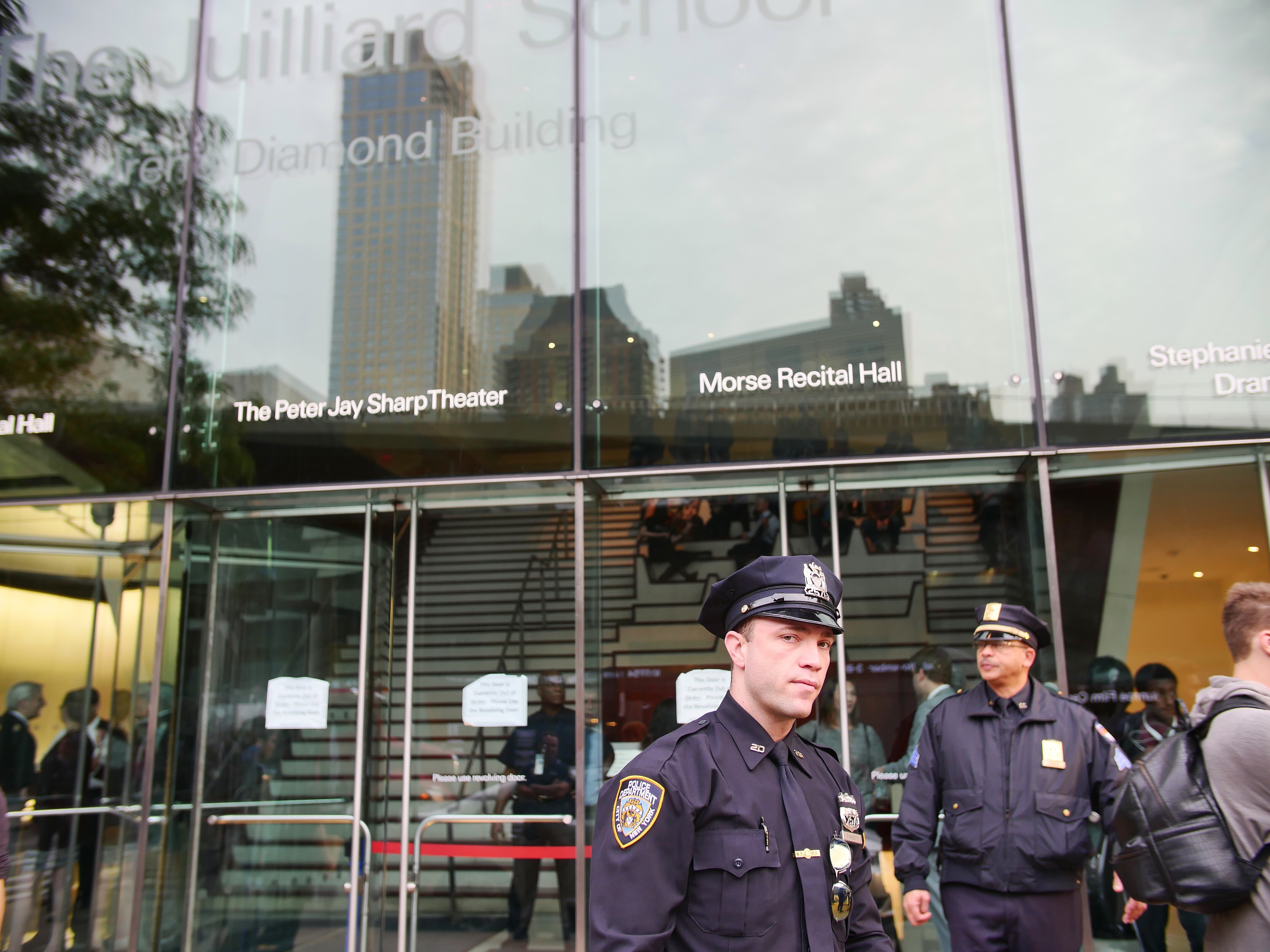
Juilliard Community Confronts Trump Presidency at Polisi Forum

As the mixed emotions of post-Election Day reached an unmatched level, Juilliard’s Office of Student Affairs invited the community to a forum facilitated by President Joseph Polisi on November 9 in the lobby of the Peter Jay Sharp Theatre on campus. As far as most current students and faculty could remember, meetings like this were rare. Similar gatherings coincided with faculty and student deaths, the attacks of September 11th, 2001, and the Vietnam War. Students and faculty filled up the lobby of the Peter Jay Sharp Theater, sitting on the floor, stairs, and all the way up to the mezzanine. Dr. Polisi stood in the center of the room speaking and responding to numerous questions and concerns.

Polisi opened the floor to passionate exclamations of fear, anger, pain, confusion, and desire for action from both students and faculty.  “People were upset, scared…overwhelmed, and I guess that’s to be expected when something this difficult for people to handle is happening,” said Joshua Elmore (BM ’20). At moments, it was difficult to find a single dry eye in the room as students struggled to predict what the future of this country or even each individual person’s safety entails. “Right now, I don’t even feel safe enough to leave this institution because I know that my body as a black, queer woman is in danger every day,” expressed Sekai Abeni (BFA ’20).

Polisi encouraged proactivity, emphasizing the step forward it would amount to “if every one of you, or half of you, for that matter, decided to become more politically active.” He also asked those present to try moving past the election results and consequently find ways to affect change during the reality of a Trump presidency. However, this solution appeared to be easier said than done for some. “I see somebody who’s just been elected to the presidency who has publicly been endorsed by the Klu Klux Klan, who has publicly spoken out against queer people, who has publicly been a racist figure and has been elected to the presidency,” said Abeni, explaining the difficulty of moving past this result.

One purpose of this gathering seemed to be to come together as a unified community and to console one another. As such, the meeting could not provide any reassurance of the post-election effects, which left some still feeling uneasy. “I really thought it was going to be a place that we could talk about what the next steps were, specifically in ensuring [Juilliard students’] safety and well-being,” Abeni told The Citizen-Penguin after the meeting, noting “how beautifully diverse this school is.”

Polisi addresses the Juilliard community at post-election forum. Photo: Manon Gage

Still, while many students despaired over Trump’s win, their sentiments were not unanimous. “Damning” conservative voters and blocking them on social media drew ire with student Brendan Thomas, especially given the Democrats’ message of tolerance. In a Facebook post quoted here with permission, Thomas said, “If you are pissed because they don’t have the same views as you [then] you are in return guilty of the same character flaws you are projecting onto your rival party voters. Food for thought.”

Many students believed that the meeting accomplished a strong sense of unity within the Juilliard community. The gathering felt “sad, angry, tense, yet cathartic,” Mitchell Kuhn (BM’17) said. “It was a beautiful moment in that it unified the voices of Juilliard. It provided a safe space to air out grievances, to feel upset, to show support.” To have such an opportunity to speak up, students were reminded of how they can unify as a community and as artists to stand up for what they believe in. The discussion turned to peaceful demonstrations, using art as a powerful tool.  “In six years, I’ve never felt more like I’m a part of a Juilliard community,” said Zach Green (MM ’17).

At the gathering, Dr. Polisi offered a call to arms for students to organize, saying Juilliard students “may be a new generation of leaders that we haven’t seen since the seventies.” He continued:

“Juilliard is here to support you and protect you and educate you. We care about you. But ultimately, the most powerful way that you can make a difference is to empower yourself. And once you have that discipline and power and match it with your abilities as artists, that can be a very powerful process. But it’s not going to be a quick process, either.”

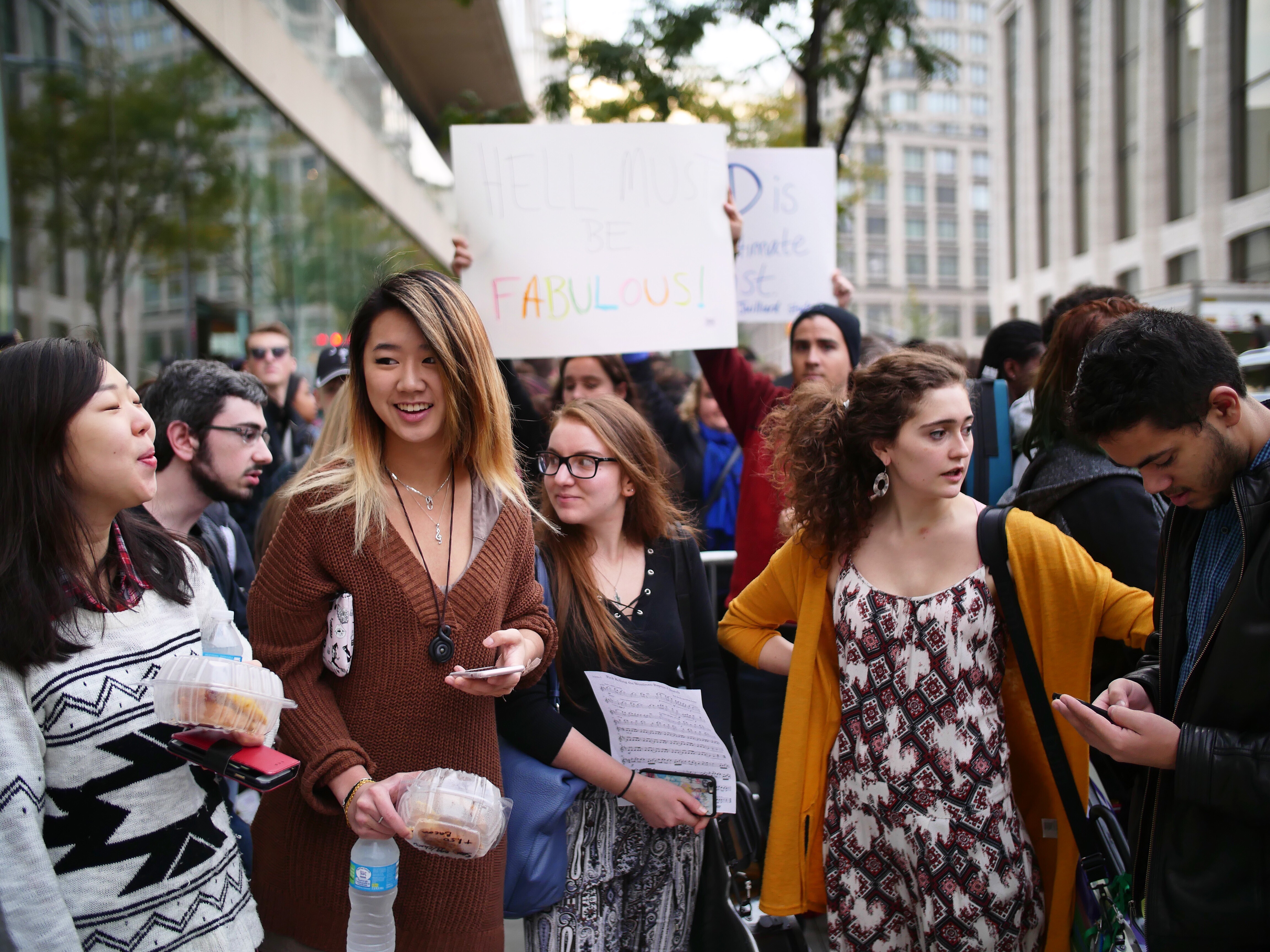
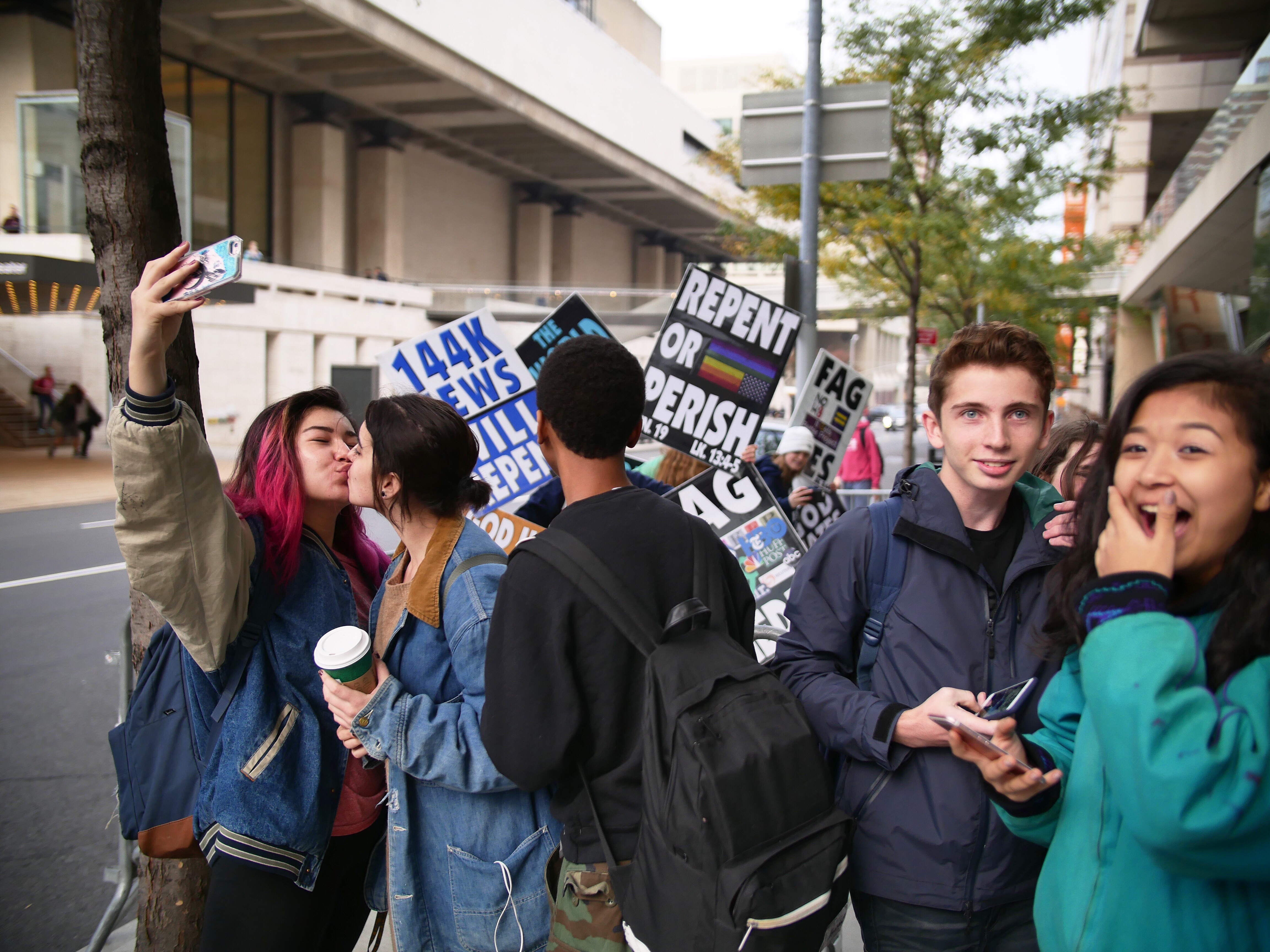
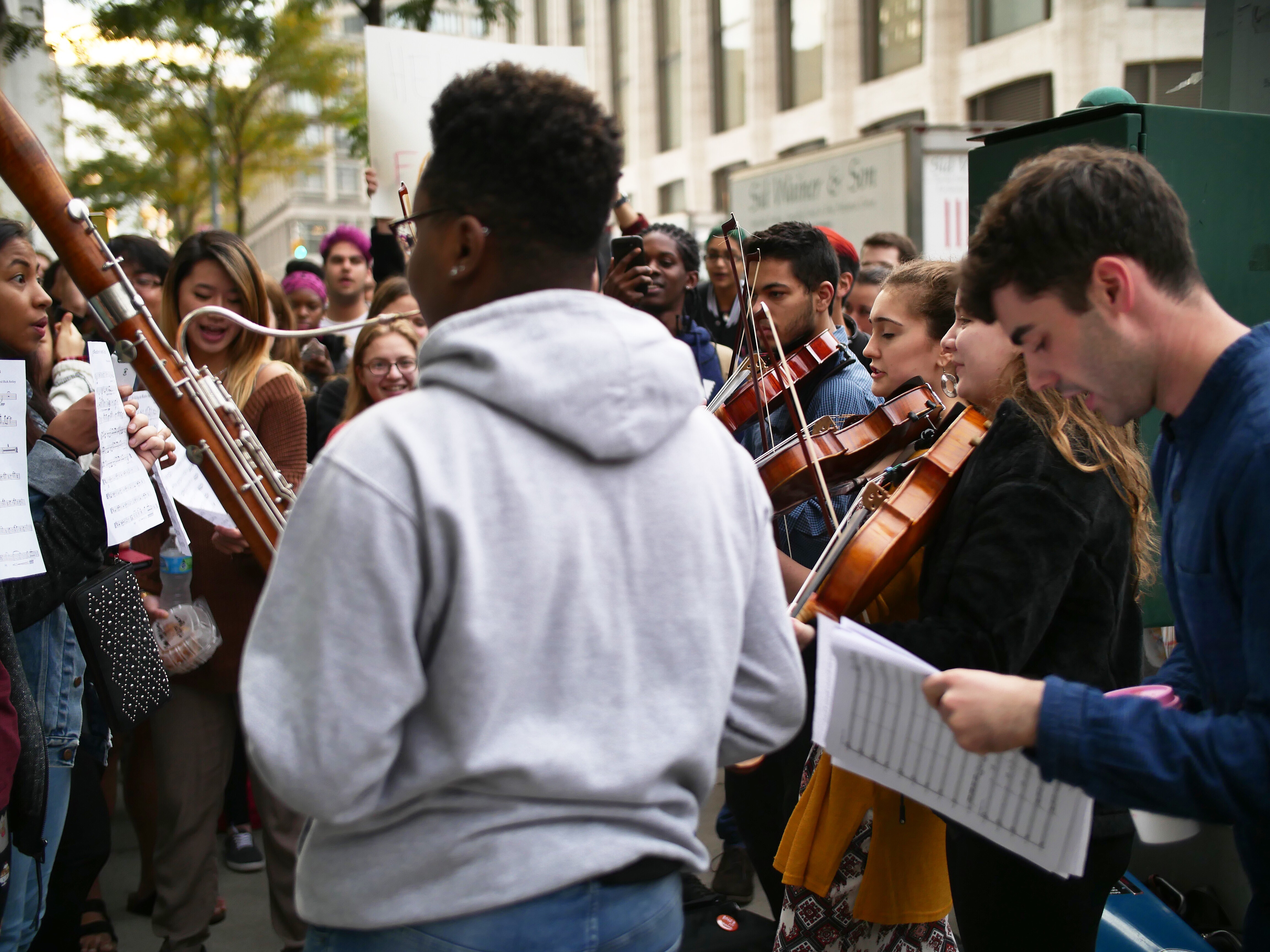
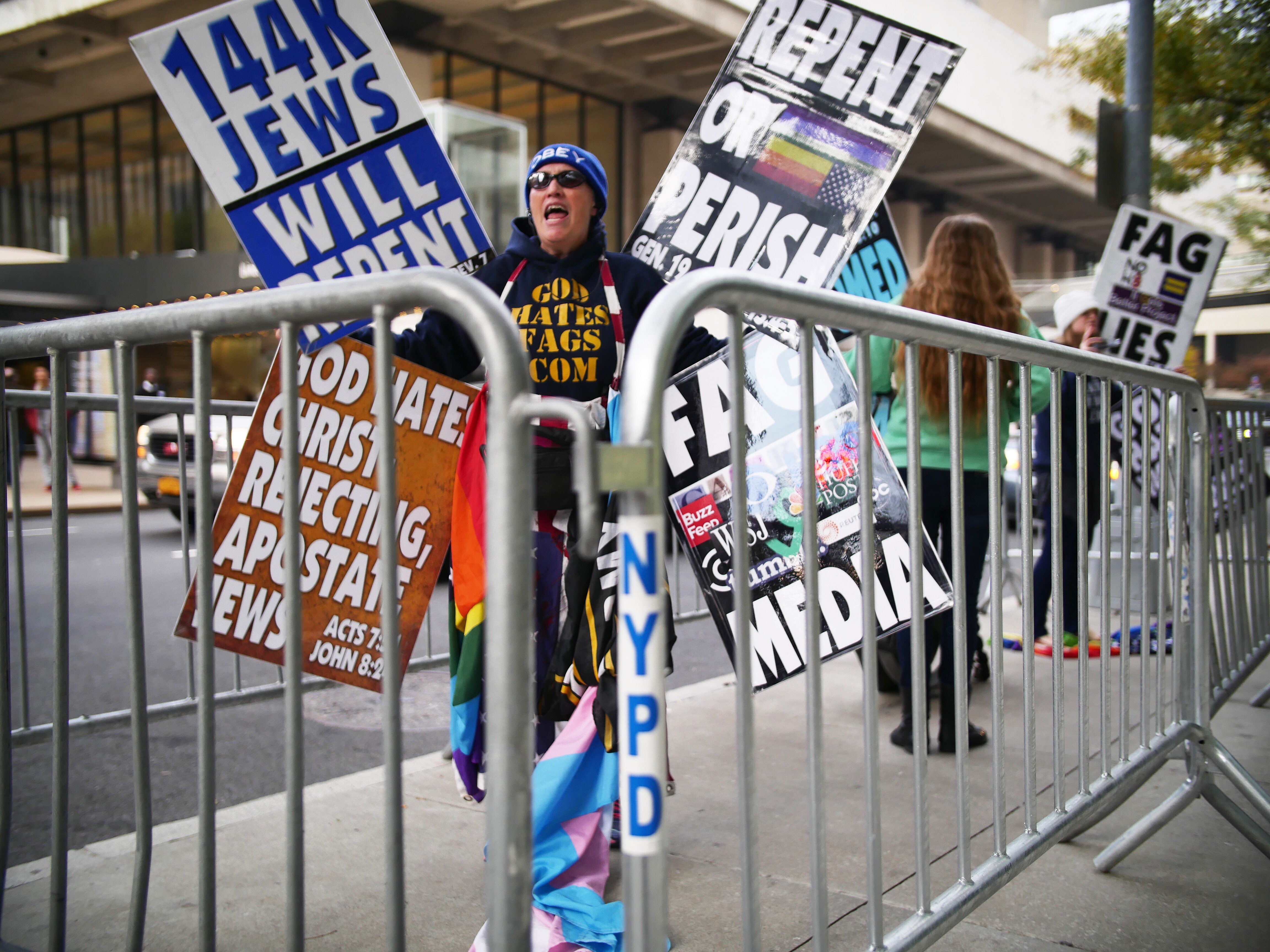
Why Showing Up Matters: student counter-protest (photos by Daniel Davila)

Leaning up against her own picture outside the school, Jayme Lawson, a second year Drama student, tilts a curious head towards the sight of the day.

“I heard about this protest yesterday, and thought it was absolutely ridiculous that some people felt the need to spread hatred to our school. Luckily, a couple of students decided to have a protest of love, and I’m all about that. I don’t understand why anybody would seek to hate the arts. It seems like another reason to incite hatred in their own lives. And I don’t understand why anybody would choose to hate, ever.”

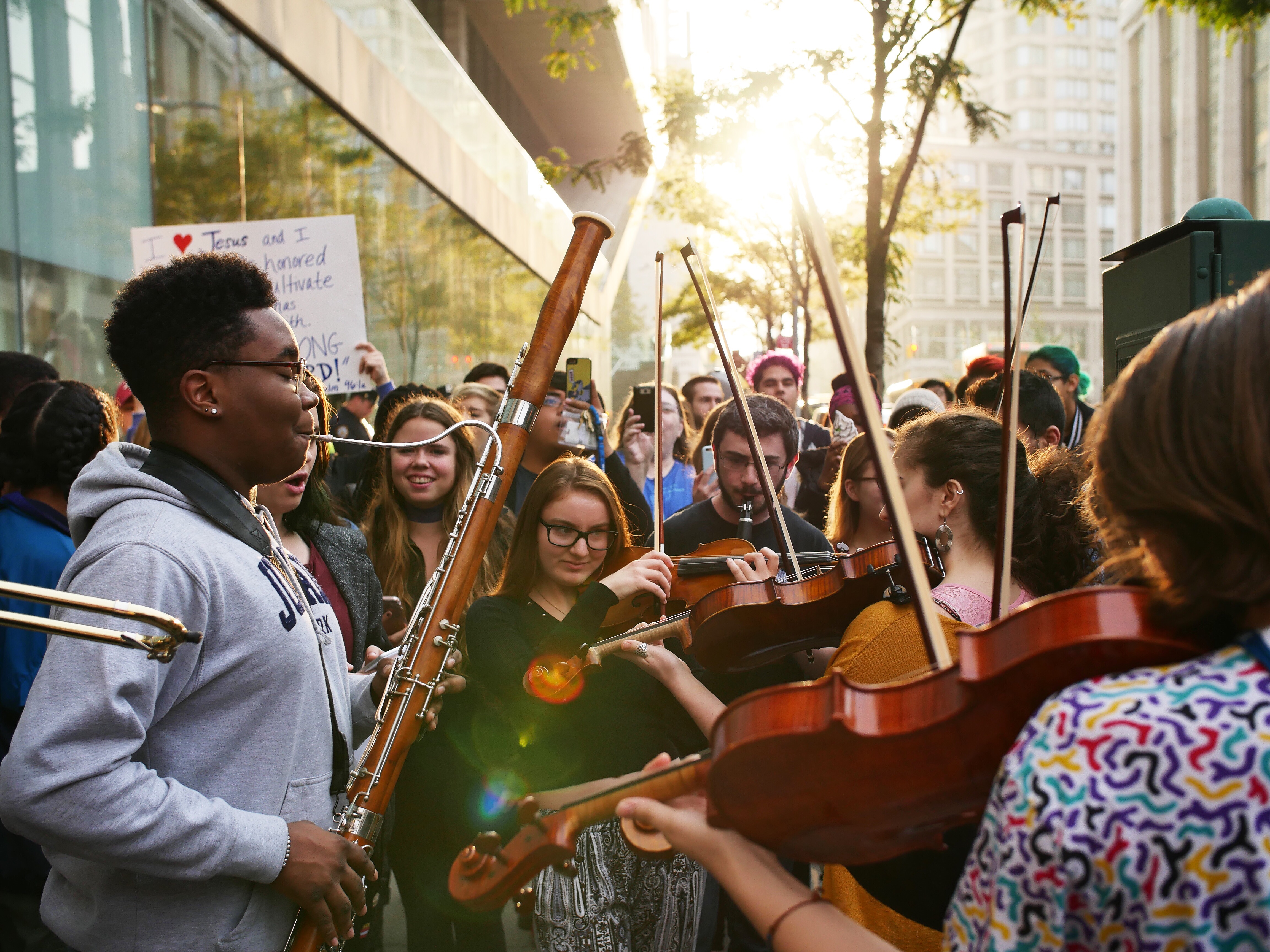
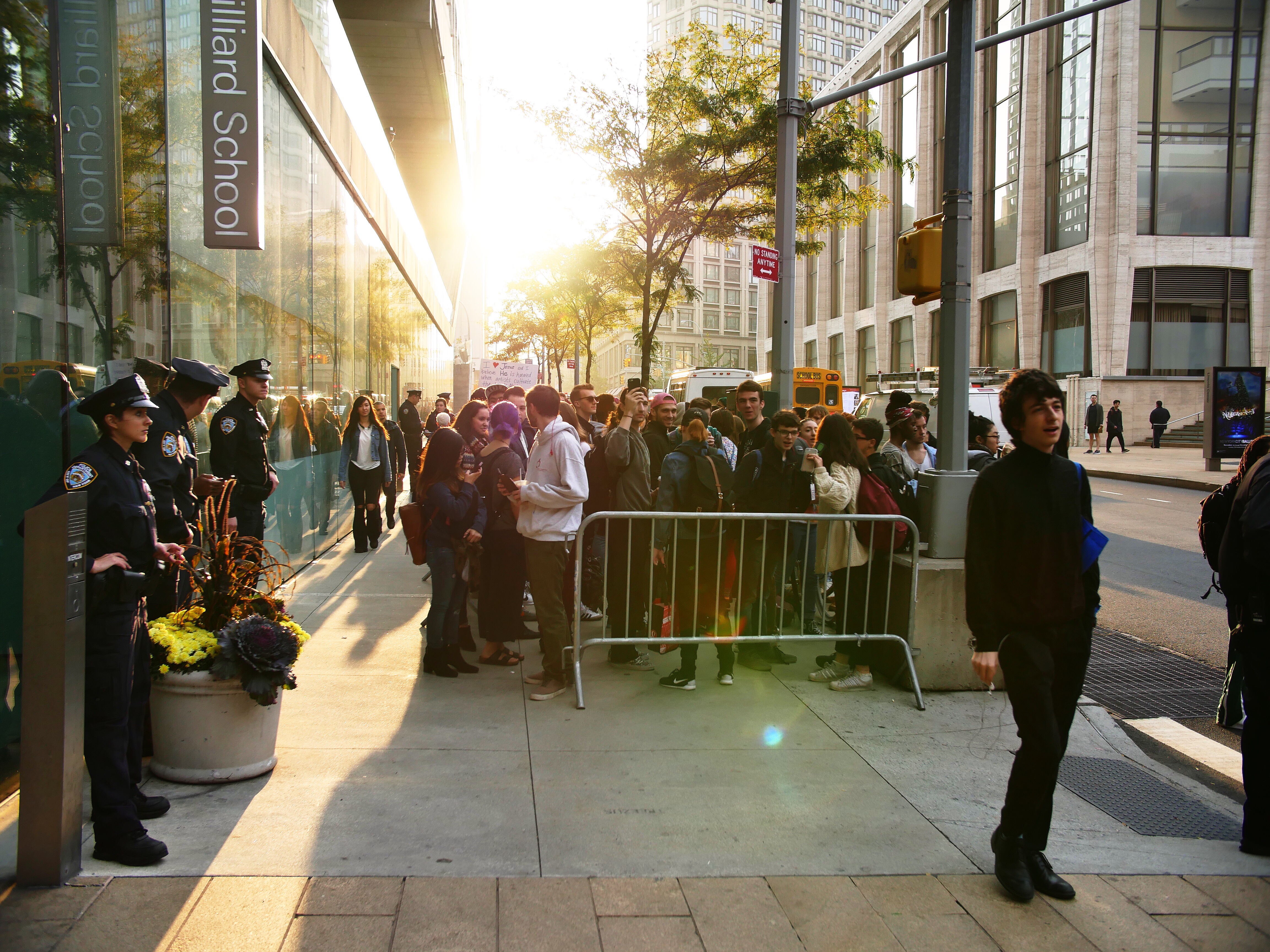
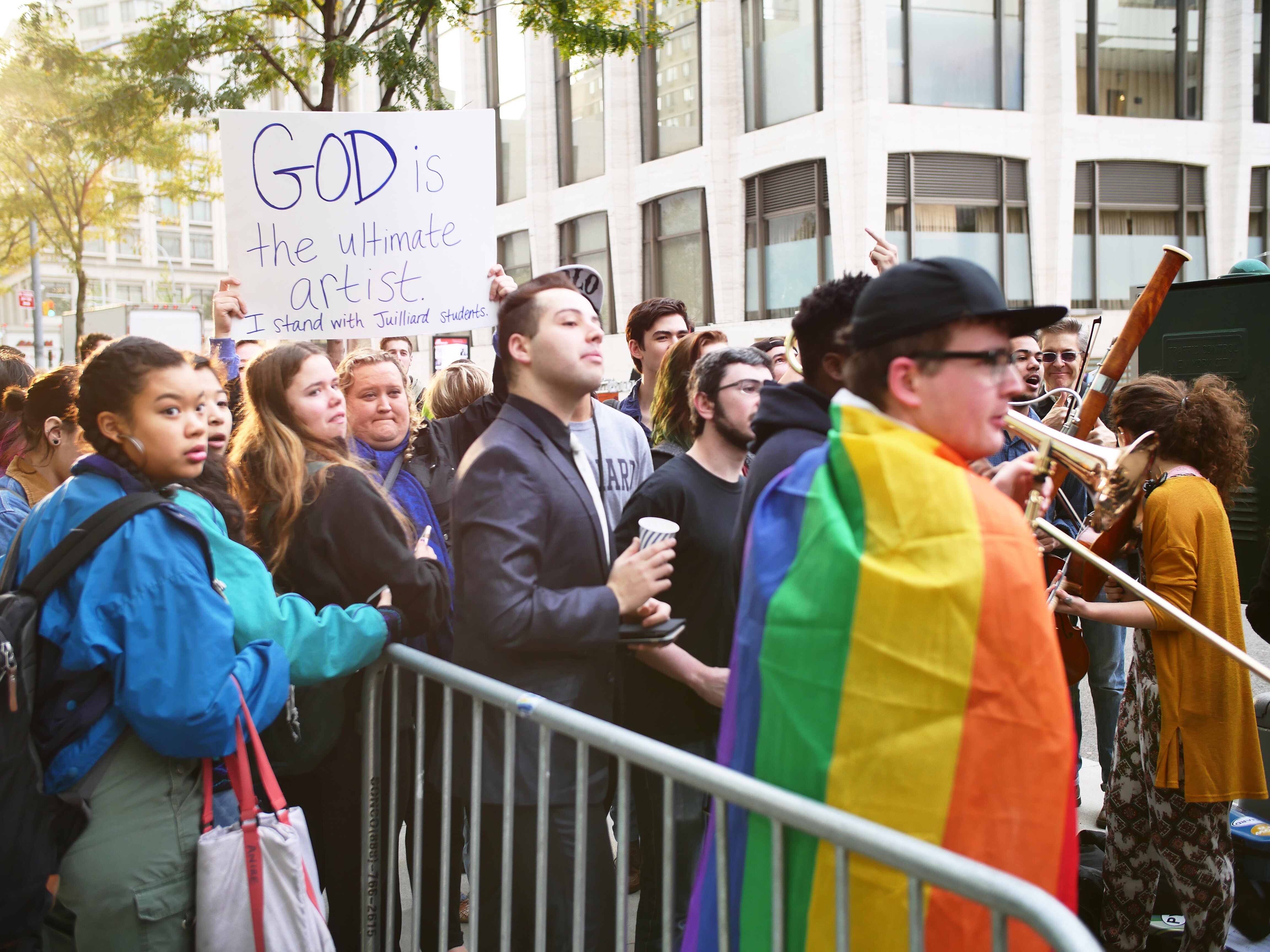
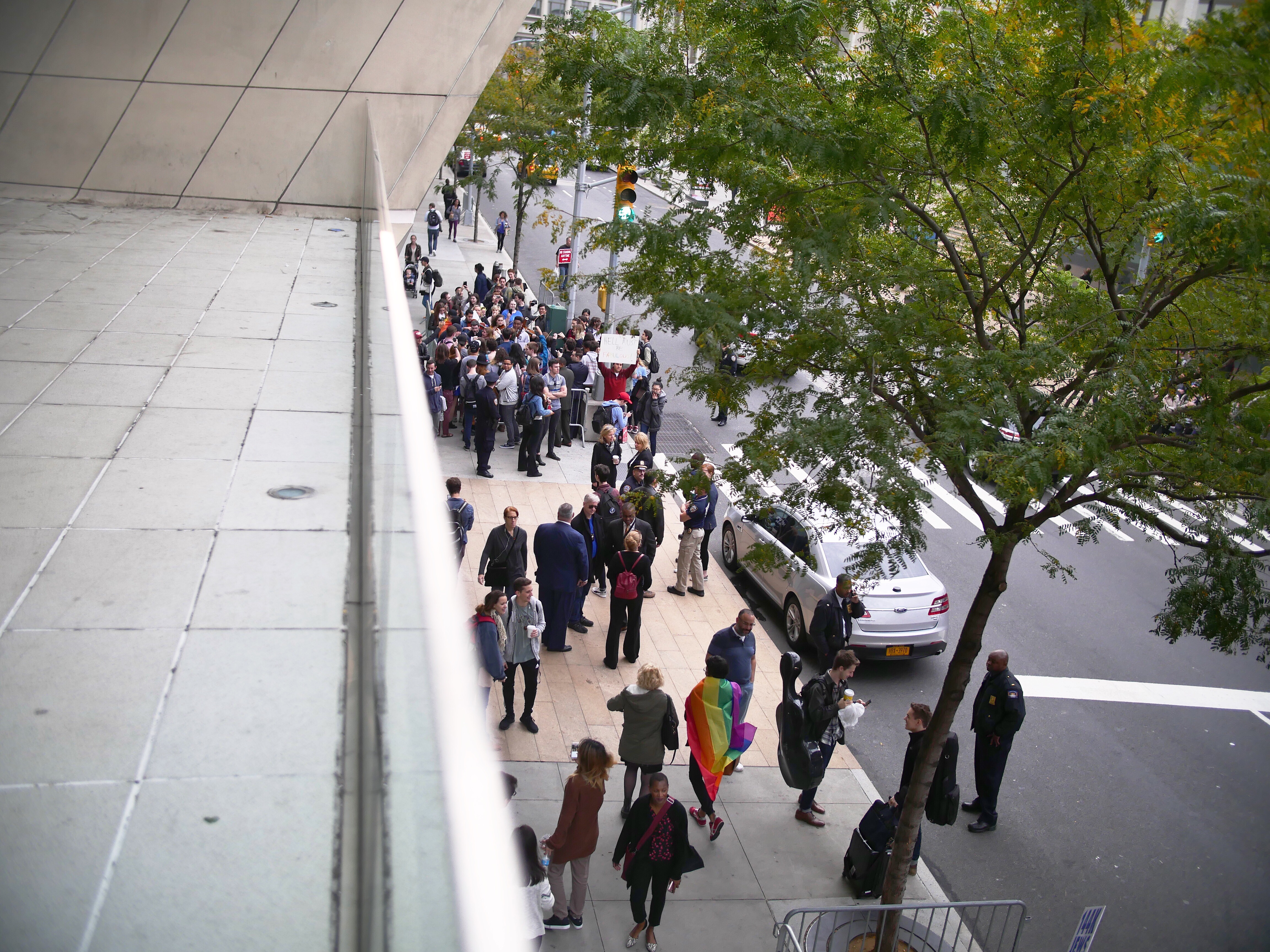
We all know that the Westboro Baptist Church came to picket in front of Juilliard this past Thursday. Three Caucasian women claimed a few squares of sidewalk in sweatshirts and wooly hats, American flags beneath their feet and the church’s infamous signs in hand. Besides the homophobic and Anti-Semitic proclamations, others held flashy phrases such as “The World Is Doomed” and “Mourn For Your Sins.” These women didn’t raise their voices, hand out pamphlets or attack pedestrians. They stood, garbed in slogans, and waited. One woman had headphones in and bounced to her WBC music while people passed by. Half a block away, Ruaridh Patterson, recent alum, bore the scene with instrument in hand and a rainbow flag caped around his back.

“I want to give a voice to the other side of the argument. The Westboro Baptist Church is picketing the Juilliard School and they equate what we do with vanity. I don’t think any of us do it for vain reasons, or the audience of whatever medium we’re in.”

Naturally, the message of the organization provokes anger, which is exactly what they want. The Kansas-based Church has made more than a pretty penny off of lawsuits regarding physical assault from bystanders over the past decade.

Rowan Vickers, drama alum, chose to stand his ground and shouted lines of Shakespeare in retaliation. I asked him what inspired him to come back to school that chilly morning. “I am here to stand in protest of the WBC and in solidarity with my brothers and sisters, gay, straight, black, white, artists and non-artists. We all need to stand in unity and brotherhood and sisterhood and stomp out the hate. I think that one of their claims is the vanity of the arts and that we all need to submit to God and to use our time on earth to worship him and carry out his will. If his will is what they say it is, he is not God. He is the devil. I don’t know specifically why they’re here today but I know why I’m here today: to step up to them.”

My initial response to the WBC was disappointment. Where were the oversized crucifixes and megaphones? Where were the demonizing screams telling me that I was going to burn in hell? Curiosity finally got the better of me and I approached the youngest of the three, who was probably the same age as me. Her response to my questions were as mundane as the phrases on her sign, verbatim straight from the church’s website.

“Go read Romans 9, or I can read it to you, it’s amazing, just a part! He’s God! He can do whatever he wants! Romans 9 Guys! I’m not telling you that your life is vain. If this is what you’re going to make your life about, this is what God says, if you’re guided to keep his commandment, use what you’ve got to serve God.” When I asked her about her mother who was still bouncing to her hymns, she explained: “She’s using an art to serve God. That’s what we’re telling you to do. That’s that. One hundred percent of your duty is to serve God.”

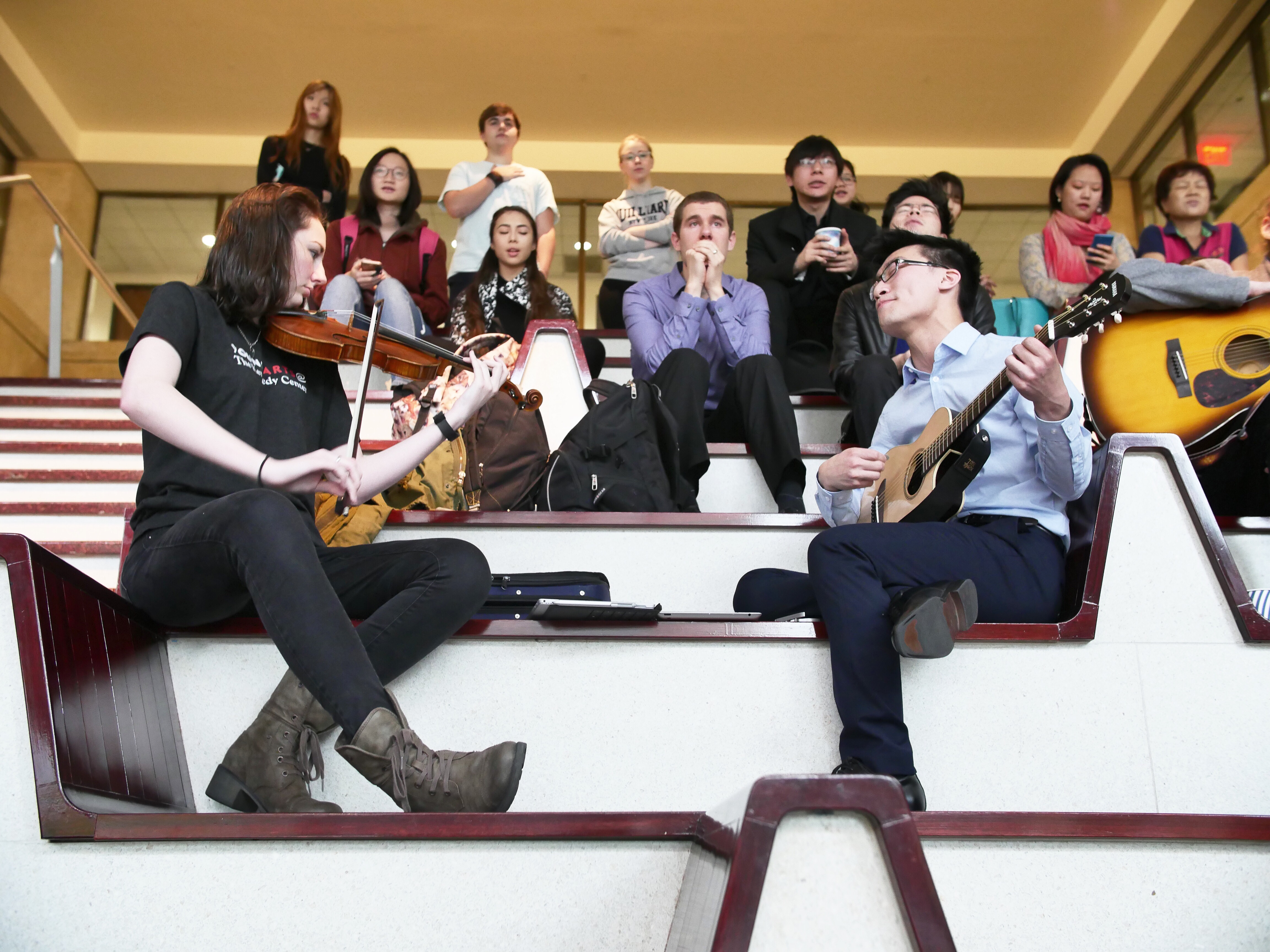
Perhaps this is something greater than a small demonstration of a hate-group. This raises questions of how we can politicize our art to create good in the world, as citizens, performing artists and as decent human beings. That morning, I saw the politicization of art for good; I saw the unstoppable defense of a wall of sound that permeates through hate; how a pirouette or a verse of Hamlet can become a valiant resistance to the ambiguities of discrimination. Music brings us together-whether you’re playing the pit or holding up the sheet music for a friend.

Dean Adam Meyer stood from afar among many faculty members:

“I think it’s sad that we live in a world where three people and the Internet have the power to spread such a hateful message—what a waste of energy! In a way, by showing up and counter-protesting, we gave this horrible group what they wanted, which is attention. But in the end, the positive student response greatly overshadowed their bigotry, and Juilliard proved once again that love trumps hate. Personally, I was very moved that the protesters were met with music, kindness and generosity of spirit, which only served to bring the community together in a unique and powerful way.”

Disregarding all cheesiness, I guess you could say I saw what it really takes to be an Artist as a Citizen. To quote Joseph Polisi, the man that coined the phrase:

“On the west side of the building entrance we saw hate, bigotry, and ignorance. On the east side and just inside our building we saw hope and empathy, accompanied by music.”

We are all trying to grow up. We all want to be the next star of our field that Juilliard will brag about. Seeing a bunch of young artists huddled on the sidewalk reminded me of our youth, and that our powers lie not in our fame or our money but our talent, our raw, unclean passion.

That morning, we skipped breakfast and sacrificed an hour of sleep to stand up with our weapons of craft and waited, unshaken but trembling together.

Daniel Hass and Leerone Hakami contributed material to this article.